If you have ever stood across from Alamo Square Park and wondered why the homes feel so dramatic, layered, and unmistakably San Francisco, you are not alone. This neighborhood has one of the city’s most recognizable streetscapes, but the real story goes far beyond the Painted Ladies. Understanding the architecture here can help you spot style differences, evaluate renovations, and make smarter buying or selling decisions. Let’s dive in.
Why Alamo Square Looks Distinct
Alamo Square is a large residential historic district centered around Alamo Square Park. According to San Francisco Planning, the district was designated in 1984 and includes 16 blocks and 281 parcels, generally bounded by Golden Gate Avenue, Divisadero Street, Webster Street, and Fell Street.
Its look is closely tied to the park’s hilltop setting and to late-19th-century transit. San Francisco Planning notes that cable cars and later electric streetcars attracted affluent buyers to the area, especially those drawn to park views and architect-designed residences.
Over time, the neighborhood evolved. Large single residences were joined by flats and apartment buildings as demand changed, but the overall historic character stayed remarkably intact.
Today, that combination of architecture, central location, and visual appeal makes Alamo Square a major destination. San Francisco Recreation and Parks describes it as a quintessential San Francisco scene, with Postcard Row standing out as one of its best-known views.
Key Features Across the District
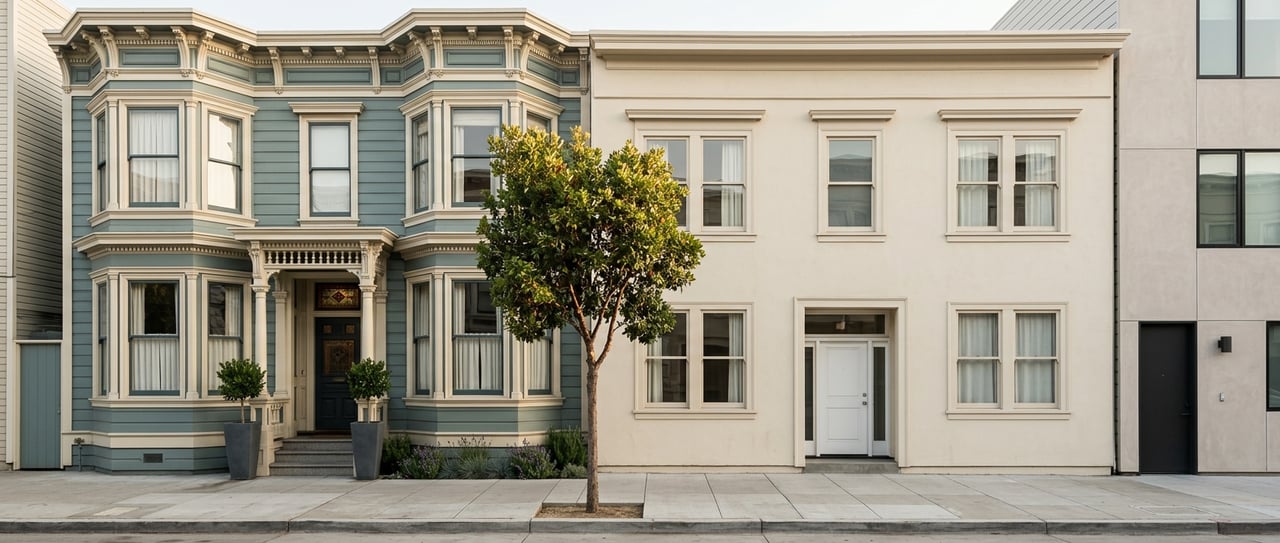
Even with different styles on the block, Alamo Square has a strong visual rhythm. San Francisco Planning describes the district as unified by relatively small-scale wood buildings, rich ornament at entries and cornices, and hillside adaptations like raised basements and retaining walls.
That means you will often notice a few recurring elements:
- Wood-frame construction
- Decorative entry details
- Prominent cornices and trim
- Bay windows in varied shapes
- Raised basements
- Homes fitted to sloped lots
These repeating details are part of why the neighborhood feels cohesive even when individual homes look quite different from one another.
Victorian Styles in Alamo Square
Victorian is the broad term for many of the district’s 19th-century homes. San Francisco Planning defines the city’s Victorian period as roughly 1860 to 1900 and describes it as a time of multi-textured walls, asymmetrical facades, steep roofs, and elaborate detailing.
In Alamo Square, three Victorian styles show up often: Italianate, Stick/Eastlake, and Queen Anne. Each one has its own personality, and learning the basics can make the streetscape much easier to read.
Italianate Homes
Italianate homes are often among the easiest to identify once you know what to look for. In San Francisco, this style is associated with straight rooflines, bracketed cornices, and often a strong bay-window presence.
San Francisco Planning also notes that angled bay windows are a common clue. If the front bay feels clean, strong, and slightly more restrained than its neighbors, you may be looking at an Italianate design.
Stick and Eastlake Homes
Stick and Eastlake homes tend to look more geometric and linear. They often feature visible bracing, open brackets, square or turned porch columns, and ornamental woodwork.
These homes can feel decorative without being overly curved or theatrical. Planning guidance points to more rectangular, muscular bay windows as a useful visual clue for this style.
Queen Anne Homes
Queen Anne is often the most exuberant style in the district. These homes are known for asymmetrical massing, towers or turrets, varied siding, and highly decorated gables.
If a house feels especially elaborate or playful, Queen Anne is a strong possibility. In Alamo Square, ornate curved bays are one of the clearest signs of the style.
Where the Painted Ladies Fit
The Painted Ladies are iconic, but they are not a separate architectural era. San Francisco Planning and preservation materials describe them as Queen Anne and Victorian-era houses within the larger Alamo Square historic fabric.
That distinction matters if you are trying to understand the neighborhood as a whole. The famous row across from the park is the best-known image, but it represents a broader pattern of Victorian design that extends throughout the district.
Edwardian Buildings Add Another Layer
Not every classic-looking home in Alamo Square is Victorian. San Francisco Planning defines the Edwardian period as 1901 to 1910 and notes that in San Francisco, the term often refers to multi-unit flats or apartment buildings.
In Alamo Square specifically, planning documents state that about half of the district is Victorian and about one-third is Edwardian. Some later apartment buildings reached as high as six stories and replaced earlier large dwellings.
Edwardian buildings usually feel more restrained than Victorian homes. They play an important role in the neighborhood because they bridge the shift from ornate single residences to denser, more practical housing forms.
How Floor Plans Often Work
Alamo Square homes were built for vertical city living, not wide suburban layouts. San Francisco Planning notes that many large houses included raised basements that could house servants, extended family, or rental units.
Later, many of these residences were divided into smaller apartments while keeping their historic exteriors intact. For buyers, that means the inside of an Alamo Square property may be more flexible and layered than the facade first suggests.
A typical older home here may feel:
- Tall and narrow
- Basement-inclusive
- Split across multiple levels
- Adaptable for different household needs
- Configured differently from newer construction
This is one reason floor plan analysis matters so much in the neighborhood. Two homes with similar curb appeal can function very differently inside.
Common Renovation Patterns
In Alamo Square, many renovations follow a clear pattern: preserve the street-facing character and update the basement, rear, or side. Planning case files show repeated examples of basement expansions, rear additions, widened openings for light and egress, garage insertions, and restoration of original windows and entry details.
That tells you something important about how value is often created here. The goal is usually not to erase the building’s identity, but to improve livability while respecting what makes the facade historically important.
San Francisco Planning records also show examples of retaining or rebuilding original bay brackets, porch entries, stair materials, and wood trim in kind. For both buyers and sellers, that kind of work can be meaningful because it preserves the visual language of the block.
What New Construction Must Do
Alamo Square is not frozen in time, but new work must fit its context. In one planning review, staff asked for a larger front setback, deeper bay projections, a continuous cornice line, an aligned main entry, painted wood rather than stucco on visible facades, and a transom above the entry.
Another case described a new three-unit building as contemporary in style while still relating to surrounding structures through height, massing, materials, and detailing. In simple terms, new construction does not need to imitate a historic home exactly, but it does need to respect the block.
What Buyers and Owners Should Watch
For anyone considering a purchase or preparing to sell, the exterior matters in more than a cosmetic way. San Francisco Planning states that exterior changes in Article 10 historic districts require a Certificate of Appropriateness or an Administrative Certificate of Appropriateness.
Planning guidance also notes that garage openings can affect character-defining features such as front-yard setbacks, bay windows, front porches, and historic fences. Ordinary in-kind maintenance is treated differently from alterations, and the department encourages repair over replacement where possible.
Here are smart questions to ask when reviewing a property:
- How much original exterior material remains?
- Are the windows original wood or later replacements?
- Were basement or rear changes permitted?
- Has a garage opening changed the frontage?
- Were exterior details restored in kind?
These questions can help you understand both compliance and long-term marketability.
How Architecture Can Affect Value
Architectural character is a real part of the Alamo Square market story. Redfin reported that in March 2026, the median sale price in Alamo Square was $1,612,500, the median sale price per square foot was $990, and homes sold in about 13 days on average. The neighborhood was also described as most competitive, with a Walk Score of 97.
While price is never about style alone, preserved architectural details can shape how buyers respond to a home. A well-maintained facade, intact bays, original wood windows, and thoughtful upgrades can make a property easier to appreciate and easier to position in the market.
For sellers, documented permit history and sympathetic improvements can strengthen the presentation. For buyers, understanding which changes respected the original structure and which may have compromised it can help you judge both quality and risk.
Why Local Guidance Matters
In Alamo Square, architecture is not just about aesthetics. It affects renovation options, disclosure review, buyer perception, and how a property fits into the surrounding block.
That is why hyperlocal guidance matters so much here. If you are buying, selling, or evaluating a historic property in Alamo Square, you need more than general advice. You need someone who understands how San Francisco homes actually evolve, block by block and detail by detail.
If you want a clear read on an Alamo Square property, from architectural character to market positioning, Michelle Pender can help you navigate the details with local insight and a concierge-level approach.
FAQs
What architectural styles are most common in Alamo Square?
- The most common styles are Victorian-era homes, especially Italianate, Stick/Eastlake, and Queen Anne, along with a significant number of Edwardian flats and apartment buildings.
What style are the Painted Ladies in Alamo Square?
- Preservation and planning materials identify the Painted Ladies as Queen Anne and Victorian-era houses within the larger Alamo Square historic district.
What makes an Alamo Square Victorian easy to recognize?
- Common clues include ornate wood detailing, bay windows, decorative cornices, asymmetrical facades, steep roof forms, and raised basements adapted to the hillside.
What should buyers check before purchasing an Alamo Square historic home?
- Buyers should review how much original exterior material remains, whether windows are original or replaced, whether additions were permitted, and whether garage changes affected key facade features.
What renovation rules apply to Alamo Square historic properties?
- San Francisco Planning states that exterior changes in the Article 10 historic district require a Certificate of Appropriateness or an Administrative Certificate of Appropriateness, while in-kind maintenance is handled differently from alterations.
Why does architecture matter when selling an Alamo Square home?
- Architecture can influence presentation and buyer interest because preserved original details, documented permits, and respectful upgrades often make a property easier to market and understand.