If you are trying to picture what everyday life feels like near Dolores Park, it helps to think beyond the postcard view. This part of Mission Dolores blends park time, easy errands, transit access, and classic San Francisco housing into a routine that feels active and connected. If you are considering a move here, understanding the rhythm of daily life can help you decide whether the neighborhood fits the way you want to live. Let’s dive in.
Mission Dolores at a glance
Mission Dolores around Dolores Park is dense, walkable, and strongly residential, with layers of history and daily activity packed into a relatively compact area. The park sits between Church, Dolores, 18th, and 20th Streets, and the wider Mission is shaped by pedestrian-scale commercial corridors and lively street life.
You feel that mix right away. On one block, you may pass rows of classic flats and tree-lined streets. A few minutes later, you are at the park, on transit, or walking toward cafés, groceries, murals, and neighborhood services.
Dolores Park shapes the day
Dolores Park is the center of daily life here. According to San Francisco Recreation and Park, the park is nearly 16 acres and includes lawns, a soccer field, six tennis courts, a basketball court, a multi-use court, a playground, restrooms, and two off-leash dog areas.
That range of amenities gives the neighborhood a flexible, everyday feel. You can use the park for an early walk, a dog outing, a game of tennis, playground time, or a picnic with friends. The park is open daily from 6 a.m. to 10 p.m., which supports activity throughout the day.
Sunny afternoons are especially social. The lawns fill with people relaxing, gathering, and taking in skyline views, with the southwest corner often serving as a natural meeting spot.
A park with deep history
Daily life here also unfolds in a place with real historical weight. The Dolores Park site was once a Jewish cemetery, and the city acquired it in 1905. In the aftermath of the 1906 earthquake and fire, the park briefly housed more than 1,600 refugees.
Just west of the area, Mission Dolores adds another layer of context. San Francisco Planning identifies it as the city’s oldest building, dating to 1776. That sense of continuity is part of what makes the neighborhood feel distinct from a newer, more uniform district.
Walking is part of the lifestyle
If you like getting around on foot, Mission Dolores stands out. San Francisco Planning frames walking, bicycling, and transit as the neighborhood’s natural transportation modes, supported by commercial corridors like Mission, Valencia, and 24th Streets.
In practical terms, that means many daily tasks can happen without much planning. A coffee run, grocery stop, library visit, dinner out, or trip to the park can all fit into a short walk. The area’s street life, storefronts, and transit presence help make that routine feel natural rather than inconvenient.
BART data adds another helpful signal. In the 2024 Station Profile Study, 24th St. Mission had the highest share of riders walking from home to BART at 77%, which points to a highly walkable surrounding area.
Transit options nearby
For many residents, transit access is part of the neighborhood’s appeal. SFMTA lists J Church, 14 Mission, 14R Mission Rapid, 22 Fillmore, 33 Ashbury/18th Street, and 49 Van Ness/Mission among the routes serving the area.
BART access also supports day-to-day movement around the city and beyond. The nearest stations in the broader area are 16th St. Mission and 24th St. Mission, giving you another option for commuting or meeting friends across town.
The result is a neighborhood where you can often combine walking and transit easily. That flexibility matters if you want city living that feels connected without depending on a car for every errand.
Errands and cafés feel close at hand
One of the strongest daily-life advantages near Dolores Park is how much activity is concentrated around the park’s surrounding corridors. San Francisco Planning describes Mission, Valencia, and 24th Streets as busy, pedestrian-oriented corridors supported by storefront retail, transit, crosswalks, and active public space.
For everyday use, that means your routine can stay local. You are not just near destinations for a weekend outing. You are near places that can become part of your normal week.
A few examples help bring that to life. Ritual Coffee on Valencia is one recognizable café option in the area, and Bi-Rite Market at 3639 18th Street gives residents a nearby grocery stop between Dolores and Guerrero.
The Mission Branch Library is also currently serving in-person users from its temporary location at 1234 Valencia Street while the historic branch is being renovated. For many buyers, that kind of nearby civic amenity says a lot about how a neighborhood functions day to day.
Street art is part of the routine
Around Dolores Park, public art is not something you need to plan a separate trip to see. It is woven into the neighborhood experience. Clarion and Balmy alleys contain dozens of murals, making art part of ordinary foot traffic.
That changes the feel of everyday walking. Even a simple trip for coffee or groceries can include visual detail, color, and a stronger sense of place. In a neighborhood known for active streets, that creative layer adds to the experience.
Housing has a classic San Francisco feel
If you are exploring homes in Mission Dolores, the local housing stock is a big part of the story. San Francisco Planning notes that the area is defined more by flats than by detached houses, and that the residential character dominates.
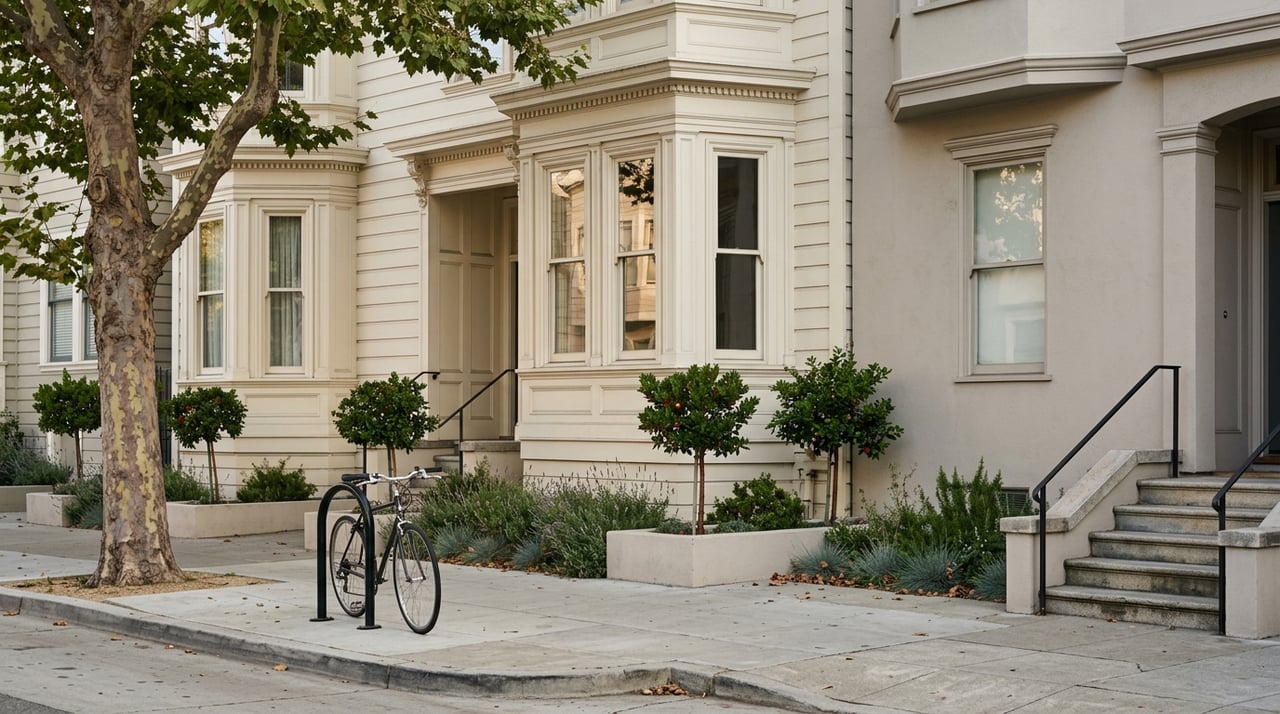
The visual character comes from Victorian, Edwardian, Mission Revival, Classical Revival, and later styles, usually on two- to four-story buildings that sit closely together on tree-lined streets. Instead of broad setbacks or large detached homes, you are more likely to see attached or closely spaced residential buildings that create a strong street wall.
The most common housing type is the flat. These are typically one-unit-per-floor, multi-unit buildings, often wood-frame, with projecting bay windows, separate entrances, and raised-basement or soft-story forms.
You may also see double flats and post-1906 Romeo flats. Single-family homes exist, but they are the exception, generally surviving Victorian-era residences on the southern and western edges or smaller cottages tucked behind street-facing flats.
What that means for buyers
For buyers, this housing mix can open up several types of opportunities. If you are looking for a condo, TIC, or another multi-unit configuration common in San Francisco, Mission Dolores may offer housing that aligns with the neighborhood’s architectural pattern and urban layout.
It also means your home search here often becomes very block-specific and building-specific. Two properties that sit only a few streets apart can offer very different layouts, outlooks, and levels of privacy. In a micro-market like this, local context matters.
That is where neighborhood knowledge can make a real difference. Understanding the building stock, transit edges, commercial spillover, and park influence can help you weigh what daily life will actually feel like once you move in.
Why Mission Dolores appeals to so many buyers
Mission Dolores around the park tends to attract people who want a San Francisco lifestyle built around access and activity. The combination of a major park, nearby transit, established housing, and busy commercial corridors creates a neighborhood where many essentials are close together.
Some buyers are drawn to the energy. Others care more about the practical side, like being able to walk to groceries, public space, cafés, or transit. Often, it is the blend of both that makes the area compelling.
The neighborhood also rewards people who pay attention to nuance. Living near Dolores Park can mean different things depending on the exact block, the building type, and how close you want to be to transit or commercial corridors.
How to evaluate fit block by block
If you are seriously considering Mission Dolores, it helps to evaluate the area through the lens of your real routine. Think about how often you use parks, whether you want quick transit access, and how much daily foot traffic feels energizing versus distracting.
A few practical questions can help:
- Do you want to be steps from Dolores Park, or just near it?
- How important is access to the J Church or nearby bus lines?
- Would you prefer a quieter residential stretch or closer proximity to Valencia, Mission, or 24th Street activity?
- Are you focused on a flat, condo, TIC, or a rarer single-family option?
- How much does architectural character influence your search?
In Mission Dolores, those details shape your experience in a very real way. This is one of those San Francisco neighborhoods where local guidance can help you narrow not just the right property, but the right pocket.
If you want a clear, neighborhood-level perspective on Mission Dolores and how it compares with other San Francisco micro-markets, Michelle Pender can help you evaluate the details and move with confidence.
FAQs
What is daily life like near Dolores Park in Mission Dolores?
- Daily life near Dolores Park often centers on walking, nearby errands, transit access, and regular use of the park’s open space, sports courts, playground, and dog areas.
What amenities does Dolores Park offer in San Francisco?
- Dolores Park includes lawns, a soccer field, six tennis courts, a basketball court, a multi-use court, a playground, restrooms, and two off-leash dog areas, and it is open daily from 6 a.m. to 10 p.m.
How walkable is Mission Dolores around Dolores Park?
- Mission Dolores is highly walkable, with San Francisco Planning identifying walking, biking, and transit as natural transportation modes and BART reporting a high share of riders walking to 24th St. Mission from home.
What transit serves Mission Dolores near Dolores Park?
- Transit serving the area includes the J Church and several Muni routes, including the 14 Mission, 14R Mission Rapid, 22 Fillmore, 33 Ashbury/18th Street, and 49 Van Ness/Mission, plus nearby BART access at 16th St. Mission and 24th St. Mission.
What kinds of homes are common in Mission Dolores?
- Mission Dolores is known mainly for flats in multi-unit buildings, along with Victorian, Edwardian, Mission Revival, Classical Revival, and later architectural styles on two- to four-story residential buildings.
Where can you run errands near Dolores Park in San Francisco?
- Everyday errands near Dolores Park can include stops along Valencia, Mission, and 24th Streets, with examples such as Bi-Rite Market, Ritual Coffee, and the temporary Mission Branch Library location on Valencia Street.